Share Article

February 24, 2026

The National Minimum Wage Is Increasing in April 2026 – Here’s Everything You Need to Know

The National Minimum Wage (NMW) and National Living Wage (NLW) will increase again in April 2026. 


For many small and mid-sized employers, this is not simply an annual adjustment. It affects payroll forecasting, salary alignment, supervisor differentials and, in some sectors, pricing decisions. 


If you employ staff in the UK, here is what you need to know. 


The New Rates from April 2026 


From April 2026, the hourly rates will be: 


  • £12.71 – National Living Wage (age 21 and over) 
  • £10.75 – Age 18–20 
  • £8.60 – Under 18 
  • £8.60 – Apprentice rate (if under 19, or 19+ in first year) 

These increases apply from the first full pay reference period starting on or after 1 April 2026. 


If your payroll cycle crosses into April, you must ensure the correct rate is applied from that pay reference period. 


Who Must Be Paid the Minimum Wage? 


Almost all workers in the UK are entitled to be paid at least the National Minimum Wage or National Living Wage, including: 


  • Full-time and part-time employees 
  • Casual workers 
  • Agency workers 
  • Apprentices (subject to age and year of apprenticeship) 

It does not matter how small your business is. The obligation applies regardless of size. 


Salary Breakdown – 2025 vs 2026 (Age 21+) 


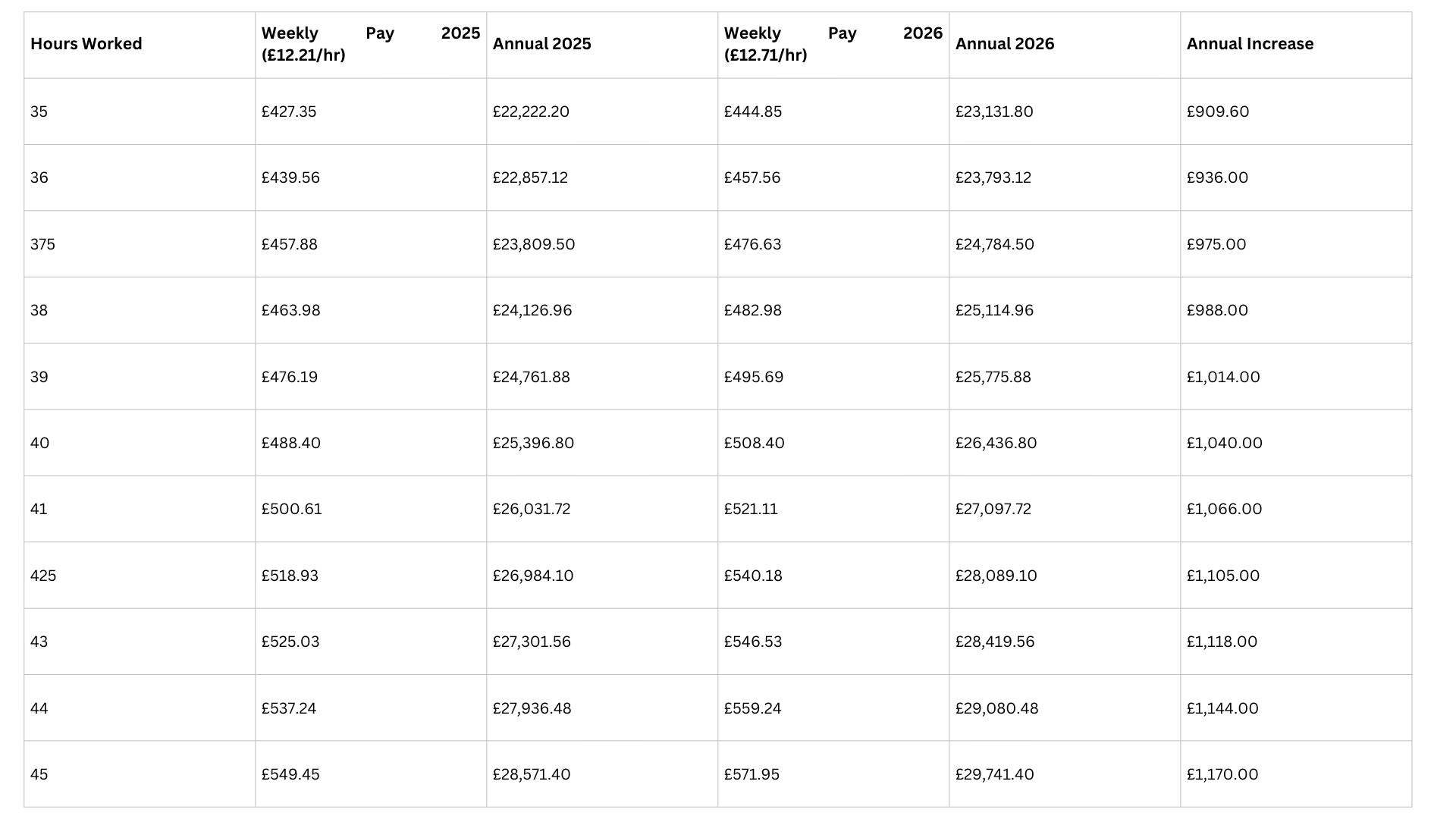
Below is an illustration of the impact moving from £12.21 (2025) to £12.71 (2026)

(Annual figures calculated using 52 weeks.) 


Even at a standard 40-hour week, the uplift equates to £1,040 per employee per year before employer National Insurance and pension contributions. 


For a business employing 20 staff on 40-hour minimum wage contracts, that represents an additional £20,800 in base wage cost annually, excluding on-costs. 


Common Compliance Risks 


Minimum wage breaches are rarely deliberate. They often arise from: 


  • Salary sacrifice schemes pushing pay below minimum thresholds. 
  • Unpaid training time. 
  • Deductions for uniforms or equipment. 
  • Incorrect apprentice rates. 
  • Failure to adjust pay immediately after a birthday moves an employee into a higher band. 

HMRC can issue fines of up to 200% of arrears (capped per worker) and publicly name employers who breach minimum wage law. 


This is not an area where informal assumptions are safe. 


What Small Businesses Should Review Now 


With April approaching, employers should: 


  • Audit current hourly rates. 
  • Confirm correct age band classifications. 
  • Adjust payroll systems. 
  • Review supervisor and experienced staff differentials. 
  • Check that deductions do not reduce effective hourly pay below the legal minimum. 
  • Forecast total payroll cost including NI and pension. 

In sectors such as manufacturing, retail, hospitality and care, the structural impact can extend beyond entry-level roles. When minimum wage rises sharply, the gap between entry-level and supervisory pay narrows unless adjustments are made higher up. 


That internal compression can create retention pressure. 


How This Fits Into the Wider 2026 Employment Law Picture 


The minimum wage increase does not sit in isolation. 


In April 2026, employers are also adapting to: 


  • Day-one Statutory Sick Pay. 
  • Strengthened family leave rights. 
  • Ongoing preventative duties around workplace harassment. 
  • Greater scrutiny of employer processes. 

The combined effect is increased operational cost and increased procedural expectation. 


Forward planning is essential. 


FAQs 


When does the new minimum wage take effect? 
From 1 April 2026, applying from the first full pay reference period starting on or after that date. 

Does the National Living Wage apply to everyone over 18? 
No. The National Living Wage rate applies to workers aged 21 and over. 

Can salary deductions reduce pay below minimum wage? 
In many cases, yes. Certain deductions (for example, uniforms or tools) can reduce pay for minimum wage calculation purposes. 

What are the penalties for underpaying staff? 
Employers can be required to repay arrears, fined up to 200% of the underpayment (subject to caps), and publicly named by HMRC. 


Need Support Reviewing Pay Structures? 


If you would like help reviewing salary alignment, benchmarking roles or planning recruitment around April’s changes, our team can support you. 


Contact Appointments Personnel to discuss your staffing structure or recruitment strategy. 

By Kerry Bonfiglio-Bains February 25, 2026
Statutory Sick Pay, maternity pay and payroll thresholds increase from April 2026. See the new SSP rates, family leave payments, Lower Earnings Limit and what UK employers must update now.
By Kerry Bonfiglio-Bains February 23, 2026
Small Business UK Employment Law Checklist 2026. Review contracts, SSP, flexible working, harassment duties, ACAS compliance and minimum wage updates to reduce legal risk.
By Kerry Bonfiglio-Bains February 21, 2026
How to prevent workplace sexual harassment under UK law. Understand the strengthened preventative duty, “all reasonable steps” requirement, third-party risk and employer compliance in 2026.
By Kerry Bonfiglio-Bains February 20, 2026
Flexible working rules explained for UK employers. Learn day-one request rights, the two-request rule, consultation requirements, statutory refusal grounds and 2026 compliance risks.
Close-up of a judge’s gavel and scales of justice on a desk with two workers reviewing documents
By Kerry Bonfiglio-Bains February 19, 2026
Avoid common UK employment law mistakes that lead to costly disputes. A practical guide for SMEs covering contracts, holiday pay, SSP changes, flexible working, probation, redundancy rules and 2026 updates.
By Kerry Bonfiglio-Bains February 9, 2026
Small and medium employers are used to juggling checklists. Payroll, recruitment, line-manager training, etc. But 2026 is different: the rules aren’t just changing, and the way decisions are judged is shifting. That makes everyday choices (flexible-working replies, sickness pay, probation calls) more likely to land a business in trouble, even when managers act in good faith. Below are the practical changes UK SMEs should prioritise now, what they mean in everyday terms, and a short checklist you can action this week. Quick summary From 6 April 2026 , some family and sick-pay rights become day-one entitlements. That affects paternity, unpaid parental leave and statutory sick pay. Statutory Sick Pay (SSP) waiting days are being removed and entitlement rules change — payroll must be ready. Collective redundancy penalties increase: protective awards can double, so consult properly or risk larger fines. These changes are rolling in across 2026; employers should focus on process, documentation and manager training , not just policy wording. What’s changing (and why it matters) 1. Day-one family rights — paternity & unpaid parental leave From April 2026, employees can give notice for statutory paternity leave and unpaid parental leave from their first day of employment. That removes the old 26-week / 12-month service tests and brings more people into scope immediately, which is good for families, but means employers must be ready to process, record and respond to requests from day one. Practical impact: update your parental-leave procedure, train whoever handles returns and leave, and make sure your contractual templates and employee handbook reflect the new eligibility rules. 2. Statutory Sick Pay: waiting days gone, wider entitlement The current three waiting-day rule for SSP is being removed from 6 April 2026, and entitlement rules are being widened (for example, the lower earnings threshold is being removed). SSP rates are also updated for 2026–27. Payroll teams need to be able to pay SSP from day one and to calculate linked periods correctly. Practical impact: talk to payroll/your software provider now. Test scenarios: short absences, linked periods, low-paid staff. Confirm how your payroll will apply the new SSP rules from 6 April. 3. Redundancy and collective consultation: higher protective awards The maximum protective award for failing to consult properly in a collective redundancy situation will increase (reports indicate a doubling to 180 days’ pay). That makes getting consultation, records and redundancy planning right far more important. Practical impact: audit your redundancy playbook, update consultation steps, and ensure you have a clear paper trail showing how decisions were reached and who was consulted. 4. The broader shift: process matters more than ever Across the Employment Rights Act and related reforms, a repeated theme is that tribunals and regulators are looking for defensible processes: consistent handling, documented reasoning and fair communication. That means the smallest missing note in a file, an informal chat that wasn’t recorded, or inconsistent treatment of similar cases can be costly. Practical impact: build manager scripts, standard templates for decisions, and a simple central filing system for HR notes. Train managers to log reasoning, not just outcomes. What SMEs should do this week (practical checklist) Immediate (this week) Talk to payroll: confirm SSP changes will be applied from 6 April 2026 and test a Day-1 absence scenario. Update your parental-leave and paternity-leave procedure to reflect day-one entitlement. Put a ‘how to’ note in the employee handbook and your manager guidance. Identify who handles redundancy consultation and map the steps — confirm who will lead and document each stage. Short term (2–4 weeks) Run a 30-minute manager briefing: how to record decision reasoning, where to save notes, how to respond to flexible-working and SSP queries. (Make it practical, use examples.) Review and update contract templates and staff handbook sections that reference qualifying periods, waiting days or eligibility tests. If you have uncertainties Keep a short list of questions and seek a 15-minute HR/ employment-law clinic rather than overhauling everything at once. Many small fixes (clear wording, a consistent file note template, payroll checks) remove most risk. FAQs Q: Do I have to update every contract before 6 April? A: Not always. Prioritise payroll and policies for SSP and parental rights, and ensure your core contract wording doesn’t contradict the new rules. Plan a phased update for full contract refresh. Q: What happens if I get it wrong? A: For individual disputes, you might face claims (and back-pay for SSP). For collective redundancy failures, protective awards can be materially higher from April 2026, so weak process can be costly. Q: Should I panic and rewrite every policy now? A: No. Start with the high-risk items: payroll SSP, parental-leave eligibility, and redundancy consultation steps. Fix the data and the decision flow; wording and full rewrites can follow on a schedule. Want a hand? If you’d rather not puzzle through the detail alone, we’re running a short, practical webinar that covers these exact points and gives you an immediate checklist to act on. Learn more about it here.
By Kerry Bonfiglio-Bains December 19, 2025
Practical insights to improve offer acceptance and avoid costly delays
By Kerry Bonfiglio-Bains November 28, 2025
If you’ve recruited over the last year or two and found yourself thinking “it never used to be this difficult”, you’re not alone. Between us, Emma and I have spent over three decades working alongside SME business owners, and one thing is clear – recruitment hasn’t suddenly broken, but the way people find, choose and commit to jobs has changed significantly. What used to work on autopilot now needs thought, planning and consistency. The market has shifted – and candidates know it Good candidates are more selective than ever. They’re not just looking at the job, they’re looking at the business behind it. How clear the role is, how quickly decisions are made, and how the opportunity compares to what else is out there all play a part. For SMEs, this can feel uncomfortable. Larger businesses may have brand recognition or bigger budgets, but SMEs often underestimate their own strengths – culture, flexibility, visibility and access to decision-makers – which are hugely attractive when positioned properly. Recruitment works best when you have a river of talent, not a tap One of the biggest challenges we see is businesses only recruiting when they have to. A resignation lands, pressure builds, and recruitment becomes reactive. The businesses that recruit most successfully tend to do the opposite. They are always keeping an eye on the market, always having conversations, and always building a small but steady river of potential talent – even when there isn’t an immediate vacancy. This doesn’t mean constant advertising. It means being visible, knowing who you want to attract, and having a plan for how you’ll engage people when the timing is right. Planning and competitor awareness make a real difference SMEs don’t need to outspend their competitors, but they do need to understand them. Knowing what similar businesses are offering, how roles are being positioned, and where salaries and benefits sit gives you clarity and confidence when you do go to market. It also helps avoid wasted time chasing candidates who were never likely to move. Clear planning upfront – role scope, priorities, budget and decision-making timescales – saves weeks later in the process. A few practical ways SMEs can attract better candidates From our experience, a handful of small adjustments can make a big difference. Being clear about who you want to attract and why they’d choose you. Moving quickly once you meet the right person. Communicating well and keeping candidates informed. And presenting your business honestly and confidently, rather than underselling what you offer. Recruitment isn’t about perfection – it’s about clarity and consistency. Getting back to confident, effective hiring Recruitment will always take time and effort, particularly for SMEs wearing multiple hats. But with the right planning, a steady pipeline of talent and a realistic view of the market, it becomes far more manageable – and far more successful. Good candidates are still out there. The key is knowing who you want, staying visible, and being ready when the right person appears. 
By Kerry Bonfiglio-Bains October 28, 2025
When you need to hire someone, the salary is just the tip of the iceberg. For small businesses especially, recruitment can be one of the most expensive and time-consuming processes you'll undertake—even if you're only hiring once every year or two. Most small business owners assume that handling recruitment themselves is the most cost-effective approach. After all, posting a job is free, right? But when you add up the real costs—especially the hidden ones—the picture looks very different. Let's break down what hiring actually costs when you do it yourself, including the expenses most business owners don't account for until they're deep in the process. The Direct Costs You Can See These are the obvious expenses that most people budget for: Job Advertising : £0-£500+ While free options like Indeed or LinkedIn exist, you often need paid listings to reach quality candidates. Specialist job boards, premium placements, and sponsored posts can run into hundreds of pounds. For hard-to-fill roles, you might need to advertise across multiple platforms for weeks. Background Checks and Testing : £50-£200 per candidate DBS checks, reference checking services, and skills assessments all add up. If you're screening multiple finalists, these costs multiply quickly. Many business owners skip this step to save money—which often leads to expensive hiring mistakes down the line. Onboarding Costs : £500-£2,000 Think equipment, software licenses, training materials, and any courses or certifications your new hire needs to get started. Total visible costs: £550-£2,700 Most small business owners stop their cost calculations here. But this is only about 20-30% of what recruitment actually costs you. The Hidden Costs That Really Add Up This is where DIY recruitment gets expensive—and most small business owners seriously underestimate these costs until they're in the middle of it. Your Time (The Biggest Hidden Cost) Recruitment is incredibly time-consuming, especially when you're doing it for the first time in a while and don't have established processes. Here's a realistic breakdown: Writing a job description and posting it : 3-4 hours (researching what to include, writing, editing, posting to multiple sites) Reviewing applications : 8-15 hours (for 50-150 applications—yes, even "simple" roles attract this many) Phone screening promising candidates : 4-6 hours (15-20 minute calls add up fast) Conducting first interviews : 8-12 hours (including prep, the interviews, and note-taking) Second interviews and assessments : 5-8 hours Reference checks, deliberation, and offer negotiation : 3-5 hours Total: 31-50 hours minimum And that's if everything goes smoothly. If your first-choice candidate rejects your offer, or you realize after a few weeks that none of your candidates are quite right, you're starting over. What's your time worth? If you bill clients at £75/hour, or your time is worth £50/hour to your business, that's £1,550-£2,500 in opportunity cost . That's money you're not earning because you're sifting through CVs instead of serving clients, developing business, or doing the strategic work only you can do. Your Team's Time It's not just you. If you involve team members in the process: Reviewing CVs together: 2-3 hours per person Conducting interviews: 4-6 hours per person Training the new hire: 10-20 hours in the first month If two team members are involved at £30-40/hour, that's another £960-£1,740 in time costs. Every hour your team spends on recruitment is an hour they're not doing their actual jobs. Productivity Loss During the Search When a position sits empty, work doesn't stop—it gets redistributed. Your team picks up the slack, which means: Projects take longer to complete Client response times slow down Quality may slip as people rush to cover gaps Team stress and potential burnout Lost sales or business development opportunities For a £30,000/year role sitting empty for 8 weeks (typical for DIY recruitment), you're losing roughly £4,600 in productivity , not counting the ripple effects on team morale, client satisfaction, and potential lost business. The Cost of Getting It Wrong Here's the really expensive part. When you're not hiring regularly, you're not practiced at spotting red flags, asking the right questions, or properly assessing candidates. The cost of a bad hire for small businesses: Salary paid during their employment (3-6 months average): £7,500-£15,000 Lost productivity and damaged work: £3,000-£8,000 Impact on team morale and additional turnover: £2,000-£5,000 Time to manage performance issues: £500-£1,500 Cost of recruiting their replacement: £4,000-£8,000 Total cost of a bad hire: £17,000-£37,500 For a small business, that's not just a financial hit—it can be genuinely damaging to your operations and reputation. Studies show that businesses that hire infrequently make poor hiring decisions up to 50% of the time, simply because they don't have the experience or systems in place to consistently assess candidates well. What Does DIY Recruitment Actually Cost? Let's add it all up for a typical small business hire (£28,000-£40,000 salary range): Successful DIY Hire (everything goes right): Direct costs: £550-£2,700 Your time: £1,550-£2,500 Team time: £960-£1,740 Productivity loss (8 weeks): £4,600-£5,500 Total: £7,660-£12,440 DIY Hire That Goes Wrong (bad hire, need to start over): All of the above, plus: Cost of bad hire: £17,000-£37,500 Total: £24,660-£49,940 Even if you get it right 70% of the time, your average cost per hire is still over £12,000 when you factor in the occasional mistake. The False Economy of DIY Small business owners often tell us: "I can't afford to pay for recruitment help." But here's the reality: you're already paying. You're just paying in: Your valuable time that could be spent on revenue-generating work Your team's time and decreased productivity Longer time-to-hire that leaves gaps in your business Higher risk of costly hiring mistakes The question isn't whether you can afford help—it's whether you can afford not to have it. A Smarter Approach You don't have to do everything yourself, and you don't need to hand over the entire process either. Many small businesses find value in getting support for the most time-consuming parts: Candidate Screening - Let someone else sift through the 50-150 applications and send you the 5-8 genuinely qualified candidates. Saves you 10-15 hours immediately. Skills Testing - Professional assessments identify who can actually do the job, not just who interviews well. Dramatically reduces your risk of a bad hire. Job Brief Creation - Get your job description right the first time so you attract the right candidates and waste less time on unsuitable applicants. Interview Support - Get help structuring interviews and spotting red flags you might miss when you only hire every year or two. The investment in selective support is almost always less than the cost of doing it all yourself—especially when you factor in your time, the speed of hire, and the reduced risk of getting it wrong. The Bottom Line Recruitment is expensive, whether you realize it or not. The costs are there—you're just choosing whether to pay them in money, time, stress, and risk, or to invest in getting it done right. The next time you think "I'll just handle this myself to save money," do the math: How many hours will this actually take you? What's your time worth? What's your risk of getting it wrong? What would a mistake cost you?  Often, the most expensive approach is the one that looks cheapest on paper. The smartest small businesses recognize that their time is their most valuable asset. They invest it where only they can add value—and get the right help for everything else.
By Kerry Bonfiglio-Bains October 28, 2025
When you're running a small business, every hire matters. Unlike larger companies that can absorb the occasional bad hire, small businesses feel the impact immediately—in lost productivity, team morale, and your bottom line. The cost of a wrong hire can range from thousands to tens of thousands of pounds when you factor in wasted salary, lost time, and the expense of starting over. The good news? Most hiring mistakes are completely avoidable. Here are the five most common (and costly) mistakes we see small businesses make, and more importantly, how to sidestep them. 1. Rushing to Fill the Position The Mistake: When someone quits or business picks up unexpectedly, the pressure to fill a role quickly can lead to settling for "good enough" rather than holding out for "great." Why It's Costly: A mediocre hire who doesn't quite fit will cost you far more in the long run than leaving the position open for a few extra weeks. You'll spend months managing their performance, redoing their work, or dealing with the disruption when they inevitably leave. How to Avoid It: Build in realistic timelines from the start. A good hiring process typically takes 4-6 weeks from posting to offer. If you're in a genuine emergency, consider temporary help or redistributing work while you find the right person. Your future self will thank you. 2. Writing Vague Job Descriptions The Mistake: Job descriptions that are too broad ("looking for a team player who wears many hats!") or just copied from a template without customization. Why It's Costly: Vague descriptions attract the wrong candidates, which means you'll waste hours sifting through irrelevant applications. Worse, the right candidates won't apply because they can't tell if the role suits them. How to Avoid It: Be specific about what the role actually involves day-to-day. Include must-have skills versus nice-to-haves. Be honest about the challenges and growth opportunities. A clear job description acts as the first filter, saving you time and attracting candidates who genuinely fit. 3. Skipping Skills Testing or Assessment The Mistake: Relying solely on CVs and interviews to gauge whether someone can actually do the job. Why It's Costly: People can be brilliant at interviews but struggle with the actual work. A CV might look impressive, but it doesn't show you how someone writes, analyzes data, solves problems under pressure, or handles your specific software. How to Avoid It: Include a practical element in your hiring process. This could be a short skills test, a work sample, or a brief trial task (paid, if it's substantial). You'll quickly see who can deliver, not just who can talk about delivering. This single step can save you from months of underperformance. 4. Not Checking References Properly (or At All) The Mistake: Skipping reference checks entirely, or just going through the motions with generic questions that reveal nothing useful. Why It's Costly: References are your window into how someone actually performs in a real work environment. Skipping them means you're hiring blind. You might miss red flags about reliability, attitude, or work quality that would have changed your decision. How to Avoid It: Always check at least two references, and ask specific questions: "Can you give me an example of how they handled a difficult situation?" or "What would you say are their areas for development?" Listen for what's not said as much as what is. If a candidate is evasive about providing references, that's a red flag in itself. 5. Forgetting About Cultural Fit and Values The Mistake: Focusing entirely on skills and experience while ignoring whether the person will actually fit with your team and company culture. Why It's Costly: Someone might be technically brilliant but if they clash with your team's working style, communication approach, or values, it creates friction that affects everyone. In a small business, one person who doesn't fit can disrupt the entire team dynamic. How to Avoid It: Define what matters to you beyond the job skills. Are you collaborative or independent? Fast-paced or methodical? Formal or casual? Ask behavioral questions that reveal how they work: "Tell me about a time you disagreed with a colleague—how did you handle it?" Let them meet the team if possible. Trust your gut if something feels off. The Bottom Line Hiring well doesn't have to be complicated, but it does require being intentional. Taking the time to avoid these five mistakes will save you money, stress, and the hassle of starting the whole process over again in six months. And remember: if you're only hiring occasionally, it's okay to ask for help. Whether it's getting a second opinion on candidates, having someone else screen applications, or running skills assessments, bringing in expert support for the parts you find time-consuming or unfamiliar can be one of the smartest investments you make. After all, getting the hire right the first time is always cheaper than getting it wrong.
More Posts