Share Article
How to Run Fair and Consistent Salary Reviews
Salary review season can feel uncomfortable for many employers.
Employees understandably want clarity about pay progression. Employers, meanwhile, are balancing wage pressures, rising statutory costs and the need to remain competitive in the market. Without a clear process, salary discussions can quickly become inconsistent or reactive.
Running salary reviews well means more than deciding who receives a pay increase. It requires ensuring those decisions are fair, explainable and aligned with the wider structure of your business.
As we move towards April 2026 when minimum wage and statutory changes take effect, many businesses across Staffordshire and Cheshire are already reviewing how their pay structures work in practice.
The Wage Pressure Employers Are Facing
Salary reviews in 2026 are happening against a backdrop of continued pay pressure across the UK labour market.
Labour Market Insight
Median full-time UK earnings reached £39,039 in April 2025, reflecting 4.3% annual growth, according to the Office for National Statistics.
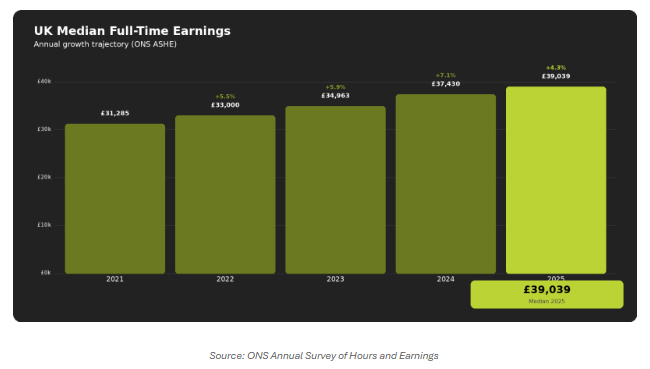
While wage growth has slowed slightly compared with the post-pandemic spike, salaries are still rising steadily, meaning employers must remain competitive to retain skilled staff.
At the same time, statutory pay changes continue to push entry-level wages higher.
Minimum Wage Context
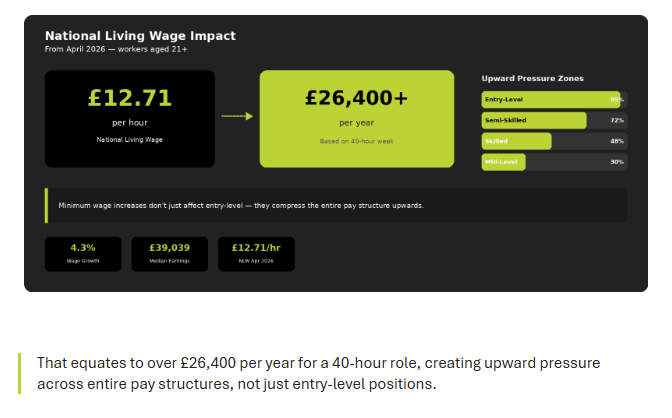
From April 2026, the National Living Wage rises to £12.71 per hour for workers aged 21 and over.
That equates to over £26,400 per year for a 40-hour role, creating upward pressure across entire pay structures, not just entry-level positions.
Start With a Clear Framework
The biggest challenge with salary reviews is often inconsistency. Two employees doing similar roles can end up with different outcomes simply because conversations were handled differently.
A structured framework helps avoid that.
Before beginning salary reviews, employers should consider:
- How performance is assessed across the organisation
- Whether pay bands exist for different roles or levels
- What criteria determine progression within a role
- How external market benchmarks influence pay decisions
This doesn’t need to be complicated. Even a simple structure helps ensure decisions are based on consistent reasoning rather than individual negotiation.
Consider the Wider Pay Structure
Salary reviews should rarely be looked at in isolation.
In 2026, many employers are already reviewing pay structures because of the National Living Wage increase and broader statutory changes. When entry-level pay rises, the gap between junior and experienced roles can narrow quickly.
If that gap becomes too small, experienced staff may feel progression is not being recognised. On the other hand, adjusting senior salaries without considering the wider structure can create budget pressure.
The key is balance. Reviewing the entire pay structure, rather than individual salaries, helps maintain fairness across teams.
Communicate the Process Clearly
One of the most common frustrations employees express is not knowing how salary decisions are made.
Transparency doesn’t mean revealing everyone’s salary. It means explaining the process.
Employees should understand:
- When salary reviews take place
- What factors influence pay increases
- How performance is assessed
- Whether external market benchmarks are considered
Clear communication reduces misunderstandings and helps employees see that decisions are being made thoughtfully rather than arbitrarily.
Train Managers to Handle Conversations Well
Salary reviews often succeed or fail at the point of conversation.
Managers should be comfortable explaining the reasoning behind pay decisions, particularly where expectations and outcomes differ.
That means preparing managers to:
- Discuss performance and contribution clearly
- Explain how salary decisions fit within company structures
- Handle difficult conversations respectfully
- Avoid making promises that cannot be delivered
Well-prepared managers create confidence in the process, even when outcomes are not always what employees hoped for.
Document Decisions
Employment law increasingly focuses on process and consistency.
Keeping simple records of salary review decisions, including the reasoning behind them, helps demonstrate fairness if decisions are ever questioned later.
Documentation also helps maintain continuity from year to year, ensuring that pay decisions build on a clear history rather than starting from scratch each time.
Why This Matters in 2026
Salary reviews this year are happening against a backdrop of broader employment changes.
Employers are already adapting to:
- The National Living Wage increase
- Changes to Statutory Sick Pay
- Greater scrutiny around fair workplace processes
Taken together, these developments mean pay decisions are receiving more attention from both employees and regulators.
A structured salary review process protects not only your employees, but your organisation as well.
Join Our Webinar: Pay Decisions in April
If you’re currently reviewing salaries ahead of April, we’re hosting a practical session exploring how employers can approach pay decisions with clarity and confidence.
Our webinar will cover:
- How minimum wage changes affect pay structures
- Practical approaches to salary benchmarking
- Avoiding pay compression issues
- Communicating salary decisions effectively
You can register here:
https://www.appointmentspersonnel.co.uk/pay-decisions-in-april-webinar
Need Advice on Salary Benchmarking or Recruitment?
Salary reviews often raise broader questions about market competitiveness and retention. If you would like support benchmarking roles or planning your recruitment strategy for the year ahead, our team at Appointments Personnel would be happy to help.